
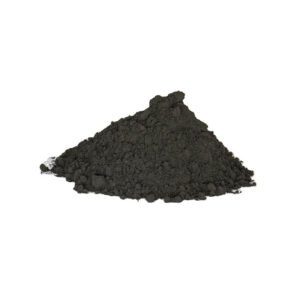
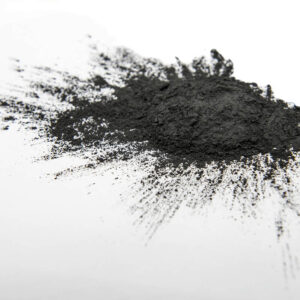
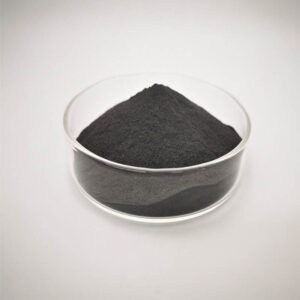
Boron carbide is an advanced non-oxide ceramic material with the typical chemical formula B₄C. It exists as black crystalline powder under normal conditions. It is synthesized mainly through the carbothermal reduction of boric oxide at high temperature.
TYPICAL PHYSICAL PROPERTIES:
| Appearance | Black powder |
| Molecular Weight(g/mol.) | 55.25515 |
| Specific Heat(cal-mol-c) | 12.5 |
| Knoop hardness | 2750 |
| Mohs hardness | 9.6 |
| Micro Hardness | 4950kgf/mm2 |
| Density&phase | 2.52g/cm(Solid) |
| Melting point | 2350℃(2623.15K) |
| Boiling point | >3500℃(>3773.15K) |
| Solubility in water | Insoluble |
| Crystal structure | Rhombohedral |
Boron carbide powder characteristics
- Extreme hardness: Vickers hardness 30–35 GPa, the third hardest known material, only softer than diamond and cubic boron nitride.
- Low density: ~2.52 g/cm³, far lighter than alumina, silicon carbide and metal alloys.
- High melting point: 2450 °C; excellent thermal stability under inert atmosphere.
- Excellent chemical inertness: Resistant to most acids, alkalis and corrosive media at room temperature.
- Strong neutron absorption capability: Captures thermal neutrons without generating radioactive by-products.
- Weak semiconductor conductivity: Unique electrical properties suitable for high-temperature electronic research.
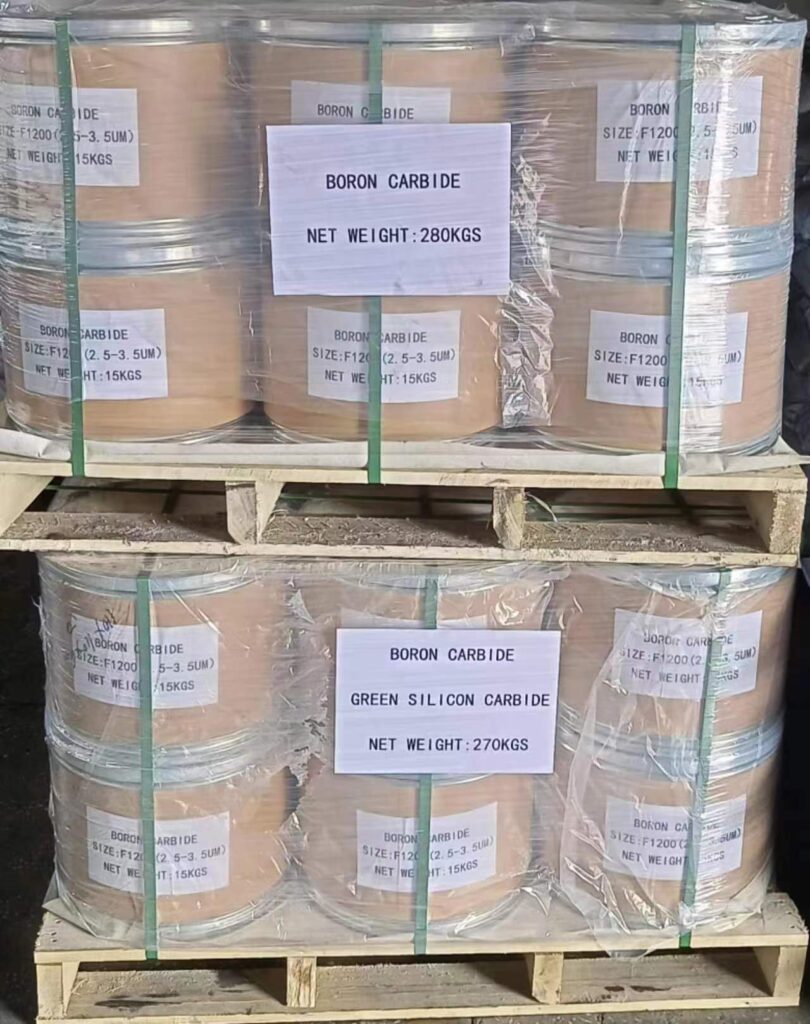
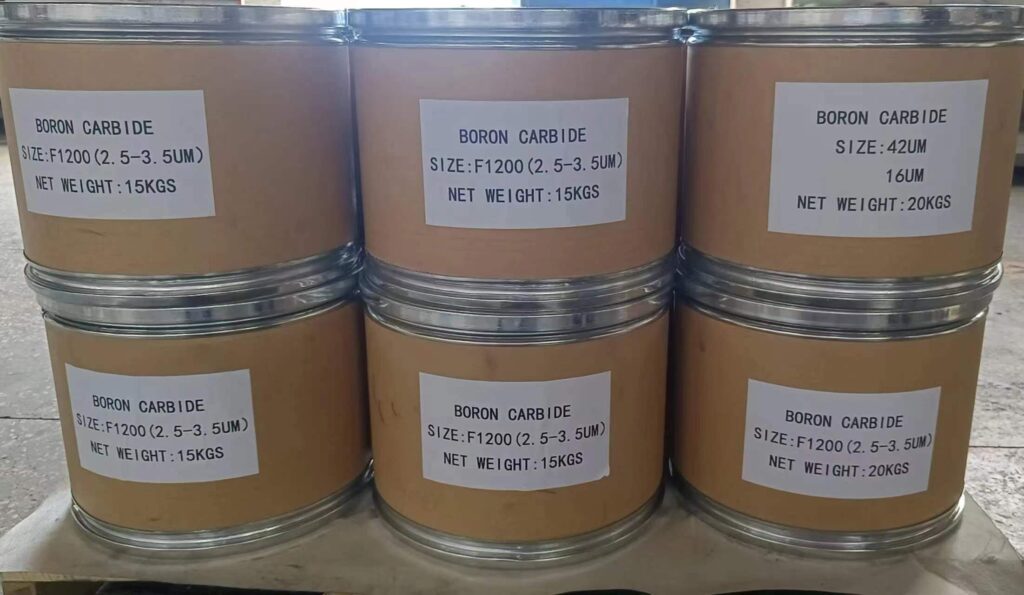
Main Industrial & High-Tech Applications
(1) National Defense & Ballistic Protection (Core high-end application)
Fine boron carbide powder is sintered into lightweight ceramic armor panels.
- Used for bulletproof vests, ballistic helmets, armored vehicle and helicopter protective plates.
- Its high hardness and low weight greatly reduce armor weight compared with metal armor
(2) Nuclear Energy Industry
One of the most ideal neutron absorber materials.
- Raw powder for reactor control rods, neutron shielding boards and emergency shutdown materials.
- Enriched \(^{10}\)B boron carbide powder significantly improves neutron capture efficiency.
- Famous application: boron carbide powder was used to terminate chain reactions during the Chernobyl accident.
(3) Abrasives, Grinding & Precision Machining
- Abrasive powder for grinding, lapping and polishing cemented carbide, sapphire, optical glass, advanced ceramics and gemstones.
- Raw material for manufacturing sandblasting nozzles, water jet cutting nozzles, grinding tools and whetstones. Boron carbide nozzles have far longer service life than tungsten carbide and alumina nozzles.
(4) Wear-resistant Ceramic Components
Powder is shaped and sintered into dense ceramic parts:
- Mechanical sealing rings, high-temperature bearings, mixing blades, corrosion-resistant crucibles, mortar & pestles for laboratories.
(5) Surface Modification & Coatings
- Raw material for preparing wear-resistant, anti-corrosion ceramic coatings via plasma spraying, PVD/CVD.
- Added into composite coatings to enhance surface scratch resistance.
(6) Metallurgical Industry
- Raw material for synthesizing metal borides, boron-containing alloys and boron steel.
- Used as deoxidizer and reinforcing phase for metal matrix composites.
(7) Advanced New Fields
- Additive Manufacturing (3D printing): Spheroidized boron carbide powder is used for ceramic 3D printing of complex high-performance structural parts.
- Composite reinforcement: Nano \(B_4C\) powder is added into polymers, metals or other ceramics to improve hardness and wear resistance.
- High-temperature semiconductor and thermoelectric material research.